On this page
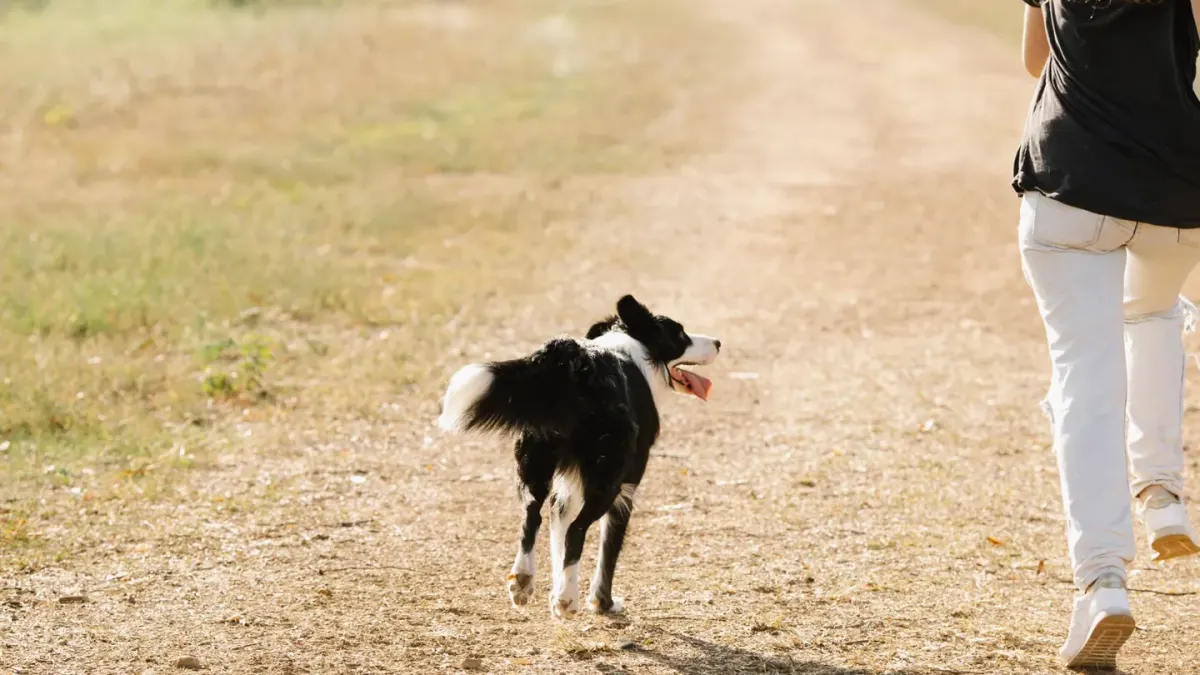
Most owners who try canicross start the same way: they clip a normal leash to a normal collar and jog off. That’s not canicross, and within a mile it usually shows — a sore wrist, a coughing dog, or a runner yanked sideways off the trail.
What canicross actually requires, before you run a step:
- A pulling harness built for the dog’s chest and shoulders, not a collar
- A padded waist belt for the runner, not a hand-held leash
- A bungee or elastic line, roughly two meters, connecting the two
- A dog with closed growth plates and a vet-cleared cardiovascular and orthopedic baseline
- A handful of verbal cues (a “let’s go,” a “left/right,” a “stop”) trained before speed is added
The gear is the sport. Wikipedia: Canicross is cross-country running with a dog attached at the runner’s waist rather than held by hand — the dog pulls, the runner’s core and legs absorb it through the belt, and the bungee line acts as a shock absorber for both bodies. It grew out of European sled-dog training, used as an off-season conditioning method for mushing teams, and has since become its own recreational and competitive sport in the UK and, increasingly, the US.
I still remember a client’s three-year-old Vizsla, Remy, forty-one pounds, who came in after his owner had spent a summer running him on a standard flat collar and a six-foot leash. Remy was pulling hard on every run — that’s simply what Vizslas do — and by August he had a persistent dry cough that started around the fourth mile and a slight head-bob at a trot. On exam his trachea was tender to palpation. Nothing dramatic, no imaging needed, but the pattern was textbook collar-pull irritation. We swapped him into a Y-front pulling harness and a hip belt for his owner, and within two weeks of easy, harness-only runs the cough was gone. The fix wasn’t rest — it was redistributing the force off his neck.
The myth: any leash and any dog will do
The assumption that “he already pulls on walks, so he’s basically ready” is the single biggest reason canicross goes wrong early. A flat collar concentrates force on the trachea and cervical spine exactly where a dog shouldn’t be taking repeated jolts at running speed. A hand-held leash transfers that same jolt into a runner’s shoulder and wrist, and it also means the runner can’t fall clear if the dog cuts sideways after a squirrel. The bungee line and waist belt exist specifically to move that load to the dog’s chest harness and the runner’s hips and core — bigger, sturdier structures built to handle repeated pulling.
The reality: age, airway, and joints decide who’s ready
Two checks matter more than fitness level or breed enthusiasm.
Growth plates. A young dog’s long bones still have open growth plates — cartilage that hasn’t hardened into mature bone — and repeated impact loading through those plates before they close can cause lasting damage. Closure timing varies widely: small and medium breeds are often done by around 12 months, while large and giant breeds can take until 18 to 24 months. There’s no way to eyeball this; if you’re unsure, an X-ray is the only reliable answer, and it’s worth asking your vet before you start structured runs, as recommended by Preventive Vet.
Airway and build. Short-nosed breeds — bulldogs, pugs, and similar brachycephalic dogs — have a harder time moving air efficiently even at rest, and pulling against resistance while running adds real strain. That doesn’t rule every one of them out of light canicross, but it changes the pace, distance, and heat tolerance you should plan around, and it’s a conversation to have with your vet rather than a guess.
A same-day sequence to start canicross right
- Fit the harness first, indoors. Check that it doesn’t ride into the armpits or restrict the shoulder’s front reach when the dog trots in place.
- Walk the belt-and-line setup before you jog. Let the dog get used to constant tension without the added variable of speed.
- Teach three cues at a walk: a go-forward word, a directional cue, and a stop/wait cue — reward heavily, repeat over several short sessions.
- Add short jogging intervals on flat, familiar ground, watching for the gait changes, head-bobbing, or reluctance that signal discomfort rather than normal effort.
- Build distance by minutes, not miles, adding modestly each week and backing off after any soreness, heat, or a hard trail surface.
That short middle scene with Remy is one dog, one outcome — not a promise of what any switch in gear will do for yours. But the mechanism behind it, force redistribution off a vulnerable structure and onto a built-for-it one, is the whole logic of the sport’s equipment, and it’s worth taking seriously from the first run rather than the first injury.

Building the dog’s body for the sport, not just the run
Ingredient-literate framing matters here, because canicross puts sustained, repetitive load on joints, tendons, and connective tissue in a way that a casual walk never does. A dog training for distance or speed is asking more of its cartilage, its recovery capacity, and its overall conditioning than a dog that only walks the block. That’s a nutrition and recovery question as much as a training one — what a dog eats, and how well its joints and muscles recover between sessions, shapes how much running its body can actually sustain over a season, not just a single run. I weigh this with owners constantly: a supplement or a diet change can help support joint comfort and recovery capacity around a running program, but it doesn’t substitute for appropriate conditioning, correct gear, or backing off when a dog is sore. The realistic role of nutrition here is supportive, not corrective — it works alongside the training sequence above, not instead of it.
For dogs already built for distance work, this is where breed matters more than most owners expect — some dogs are conditioned distance athletes by temperament and structure, and others simply aren’t, a distinction covered in more depth in Which Breeds Make the Best Running Partners. And because canicross often moves onto rougher, less controlled terrain than a sidewalk, it’s worth pairing the gear checklist above with general trail awareness — the same situational reading that applies at Dog Park Etiquette Every Owner Should Know carries over to shared trailheads and multi-dog canicross meetups.
When to loop in your veterinarian
Any persistent cough after runs, a limp that doesn’t resolve within a day of rest, reluctance to jump or climb stairs after a session, or a dog that seems to fatigue much faster than it did a few weeks earlier — those are reasons to pause the program and get an exam, not reasons to push through. Heat is its own trigger: dogs overheat faster than runners realize, especially dogs with heavier coats or shorter muzzles, and a hot, humid day is a day to shorten the run or skip it, not grind through the mileage plan.
Where this leaves you at the trailhead
Canicross rewards the owners who treat the gear and the readiness checks as the actual sport, not the paperwork before the real thing. Get the harness, belt, and bungee line right, confirm your dog’s growth plates are closed and their airway can handle sustained effort, and build distance in minutes rather than miles. That sequence — not enthusiasm, and not a dog’s obvious love of pulling — is what determines whether canicross becomes a lasting shared habit or a trip to the vet in week three.
Frequently asked questions
What's the minimum gear to try canicross?
A pulling harness sized to your dog's chest, a padded waist belt for you, and a bungee or elastic line connecting the two — a hand-held leash and flat collar aren't a substitute.
How do I know if my dog's growth plates have closed?
Timing varies by size and breed, roughly 12 months for smaller dogs and up to 18–24 months for large and giant breeds; an X-ray from your vet is the only reliable confirmation.
Sources
- Canicross — Wikipedia
- When Can You Start Running with Your Dog? — Preventive Vet